Before the Stars and Stripes: Unseen Designs for the 50-Star American Flag
In the late 1950s, as two new states prepared to join the Union, the U.S. government received a deluge of innovative and sometimes unusual proposals for a redesigned national flag.
U.S.·
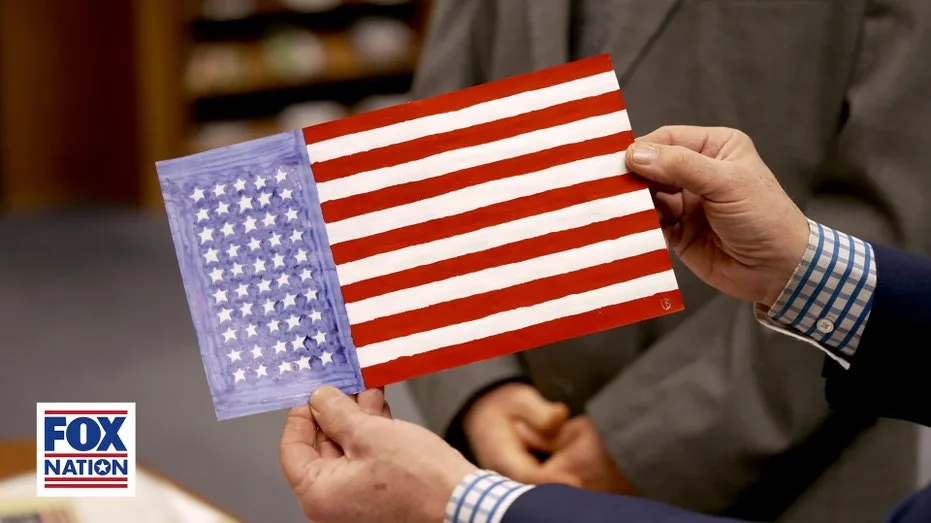
The American flag, with its iconic Stars and Stripes, is a deeply familiar symbol. However, its current design was not always a foregone conclusion, especially when the nation prepared to welcome two new states in the late 1950s.
As discussions about admitting Alaska and Hawaii gained momentum nationwide in 1958, the Dwight D. Eisenhower administration was inundated with a vast array of suggested designs for an updated 50-star flag.
Dr. Jim Ginther, supervisory archivist at the Dwight D. Eisenhower Presidential Library and Museum in Abilene, Kansas, which preserves all these historical submissions, stated, "People begin sending in ideas for how the new flag should look."
Ginther elaborated on the surge in public engagement: "Suddenly there's a massive public interest again in the design of the flag. Beginning in July 1958, the White House begins receiving designs from the public, as does the Quartermaster Corps of the Army, from all over the country and from all over the world."
A Nation's Artistic Outpouring
The first new star was added to the flag in January 1959 when Alaska officially became the 49th state. The 50th star followed with Hawaii's admission to statehood. The newly designed flag was officially unfurled for the first time on July 4, 1960, at Fort McHenry in Baltimore. This historic site, known for the War of 1812 bombardment, inspired Francis Scott Key to compose "The Star-Spangled Banner."
In the two years leading up to President Eisenhower's final selection for the new Stars and Stripes, a widespread fascination with flag design gripped the nation.
The White House ultimately received more than 1,900 proposals. Many of these submissions came from schoolchildren, often as part of lessons from the classroom publication "My Weekly Reader." Adults from across the country, and even from overseas, also contributed their design concepts.
Ginther observed the diverse nature of the proposals: "Some of them are coming in as simple as pencil drawings, some of them are as fancy as Draftsman's drawing. Some of them are sewn flags made out of cloth. Some of them are crayon drawings."
The Eisenhower administration leveraged this public interest as an educational opportunity. Every submission received a response, including a letter from a high-ranking White House official. He added, "Several publications are produced by the government about the history of the flag, about flag etiquette, about various other aspects of use of the flag that they begin to send back out to the public, along with these letters thanking them for their submissions to educate the public about the flag."
The Enduring Symbolism of the Flag
The Continental Congress officially adopted the design of the American flag on June 14, 1777, a date now observed as Flag Day. Betsy Ross is traditionally credited with designing the initial flag, which featured 13 stars arranged in a circle, representing the original 13 colonies.
While established guidelines dictate alternating red and white stripes and a blue field for the stars, the precise arrangement of the stars was never explicitly specified. This lack of specific instruction allowed for a wide range of creative, and sometimes unusual, interpretations in the submitted designs.
Despite the influx of novel ideas, a radical departure from the traditional flag design was ultimately avoided.
Ginther emphasized the flag's profound symbolism.
"The flag is symbolic," he stated. "Radical change in it is going to be difficult. People are used to that symbol. It comes out in the deliberations over the flags, in the documentation. Radically changing the flag is going to be expensive, so we have to take that into consideration as well. And then you have to consider that particularly, our military, has a vested sentimental interest, in that they have fought and bled under that flag. There is reason, perhaps, why you might not want a radical change, even though many people in the country were interested in submitting designs. There is also an argument to be made for not being very radical in a redesign of the flag as a symbol of the nation."
In the end, President Eisenhower selected a design that upheld the historical tradition, incorporating the two new stars into alternating rows of six and five stars on the blue field. This arrangement has remained familiar ever since.
The flag chosen by President Eisenhower, with its familiar arrangement of stars, continues to stand as a powerful emblem of American freedoms and ideals, particularly as the nation approaches its 250th anniversary.
Related Stories

Dramatic Footage Shows Floodwaters Breaching Student Home Doors in New Jersey
Intense flash flooding in Glassboro, New Jersey, on August 27, saw floodwaters dramatically burst into an off-campus student home near Rowan University. The event caused extensive damage to four lower-level bedrooms, as
Sep 7

Frito-Lay Worker Killed Inside Nashville Sam's Club by Stray Bullet from Nearby Lounge Dispute
A Frito-Lay worker, 55-year-old Paris Carlock, was tragically killed inside a Nashville Sam's Club by a stray bullet. The fatal shot came from an argument that began at a nearby lounge and escalated into gunfire
Sep 6

Karmelo Anthony's Family Seeks Quarter-Million Dollars for Appeal After Prior Fundraiser Drew Scrutiny
Karmelo Anthony's family has launched a new fundraising drive for his appeal, seeking $250,000 for legal costs. This follows a prior campaign that raised $633,908, leading to inquiries about how those funds were
Sep 6

California Pizza Restaurant Allegedly Operated as Major Meth Distribution Hub; Man Faces Federal Charges
A California man faces federal drug and firearm charges, accused of operating a pizza restaurant as a hub for distributing methamphetamine. Authorities reportedly seized over 40 pounds of meth, multiple firearms, and
Sep 6