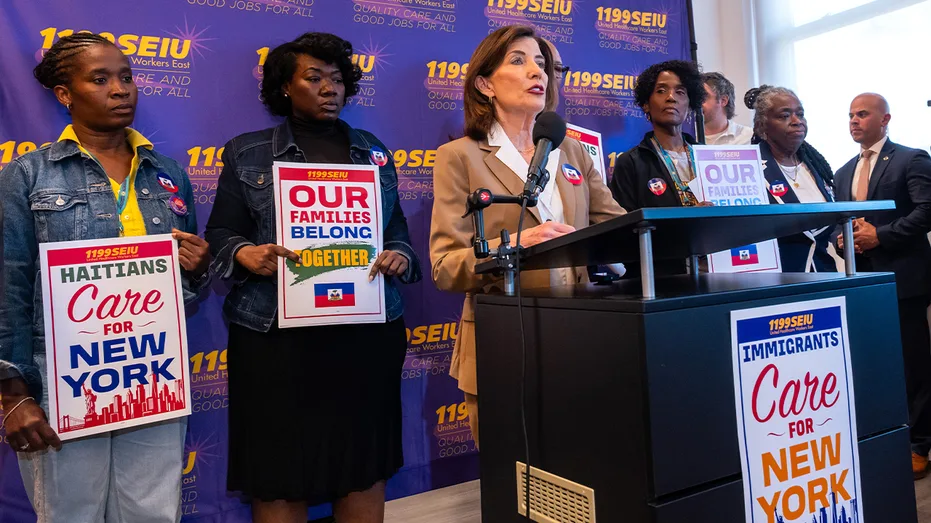
The United States Supreme Court recently delivered rulings in two significant immigration cases, upholding the Trump administration's positions. These decisions have drawn sharp condemnation from Democratic officials in states like New York and Massachusetts and even prompted a notable Republican voice to express concern over potential impacts on the healthcare system.
High Court Rulings on Immigration Status and Asylum
In a 6-3 vote in the case of Mullin v. Doe, the high court determined that Haitian and Syrian citizens holding Temporary Protected Status (TPS) are precluded from using federal courts to delay the termination of their legal status while they challenge the Trump administration's policies. TPS offers temporary lawful status to foreign nationals from designated countries experiencing conditions like armed conflict or environmental disasters, preventing their deportation and allowing them to work legally in the U.S.
A separate ruling by the court affirmed that migrants who are turned away at the southern border before physically entering the U.S. are not eligible to apply for asylum.
Blue State Leaders Denounce Decisions
Democratic leaders in New York swiftly convened press conferences to denounce the Supreme Court's decisions and vowed local resistance. New York Governor Kathy Hochul announced state-level measures, including designating "sensitive locations" to restrict Immigration and Customs Enforcement (ICE) agents and prohibiting masks for immigration enforcers.
"This is New York. We fight back. We defend our people," Governor Hochul declared. "For those who think they can come here and just tell us that that's going to be the different way that it is, you got to get to us first."
New York City Public Advocate Jumaane Williams offered particularly strong criticism, alleging the Trump administration operated with a "White supremacist lens."
"This is another day in Trump's America where we have someone in the White House who believes in fascist rules with a White supremacist lens," Williams stated. "He is doing that because his policies are based on treating people like they are not human beings, particularly if they're Black and Brown."
In her dissenting opinion on the TPS ruling, Supreme Court Justice Elena Kagan indicated there was evidence suggesting the Trump administration's decision to revoke TPS for Haitians was influenced by "racial animus." She referenced statements made prior to the 2024 election, including claims that Haitians were "eating pets in Ohio." Conversely, Justice Samuel Alito, who authored both majority opinions, pointed out that the respondents themselves had suggested the administration's stance might stem from a general opposition to TPS policy rather than targeting a specific group.
New York Attorney General Letitia James characterized the ruling as a "betrayal of who we are supposed to be as a nation." Furthermore, New York City Mayor Zohran Mamdani, whose wife is Syrian-American, announced the launch of a free municipal legal helpline to assist affected immigrants.
"The people of New York City are going to show up for you as we face down a Supreme Court ruling that just opened the door to fear instability and the threat of deportation for so many," Mayor Mamdani affirmed. He added, "... We don't let those who are afraid of what makes this city great try to divide us. We reject the politics of fear."
In Massachusetts, home to approximately 45,000 TPS beneficiaries, Governor Maura Healey criticized the decision, arguing it "makes no sense for our families, our economy, our communities, [or] our country." Boston Mayor Michelle Wu, visibly emotional, directly addressed migrants, assuring them, "You belong here."
Republican Congressman Expresses Concerns
The Supreme Court's decision also brought to light a division within the Republican party, with Representative Mike Lawler, a Republican from New York, openly criticizing the move to terminate TPS for Haitians. While Representative Lawler acknowledged the president's legal authority to end TPS, he cautioned that immediate termination could precipitate a crisis within the U.S. healthcare system, which heavily relies on Haitian workers.
"Of the 350,000+ lawful Haitian TPS holders, roughly 1/3rd work in our healthcare system," Lawler posted on X. He warned, "Immediately shutting off TPS will create a crisis in our hospitals, nursing homes, and in the I/DD community."
Lawler also highlighted the severe gang violence in Haiti, citing the State Department's Level 4 travel advisory, as evidence that the situation "continues to warrant an extension" of protections. He appealed to the administration to implement an "orderly process" over the next six months, allowing Haitian TPS holders to retain their work authorizations, and urged the Senate to consider his legislation for a temporary extension of their status.
Administration Views Rulings as Win for Rule of Law
Following the rulings, the White House and the Department of Homeland Security (DHS) commended the decisions, framing them as a victory for the rule of law. Similarly, DHS General Counsel James Percival stated on X that "the T in TPS stands for TEMPORARY, yet many of these designations became de facto amnesty." Percival concluded, "This is a win for the rule of law and common sense."