Archaeologists conducting excavations on an historic Connecticut town green have brought to light the remarkably preserved vestiges of an 18th-century bake house, a distinctive relic from the Revolutionary War era.
This structure, which served to produce bread for French military forces supporting the American Revolution, was unearthed on the Lebanon Town Green in Lebanon, Connecticut.
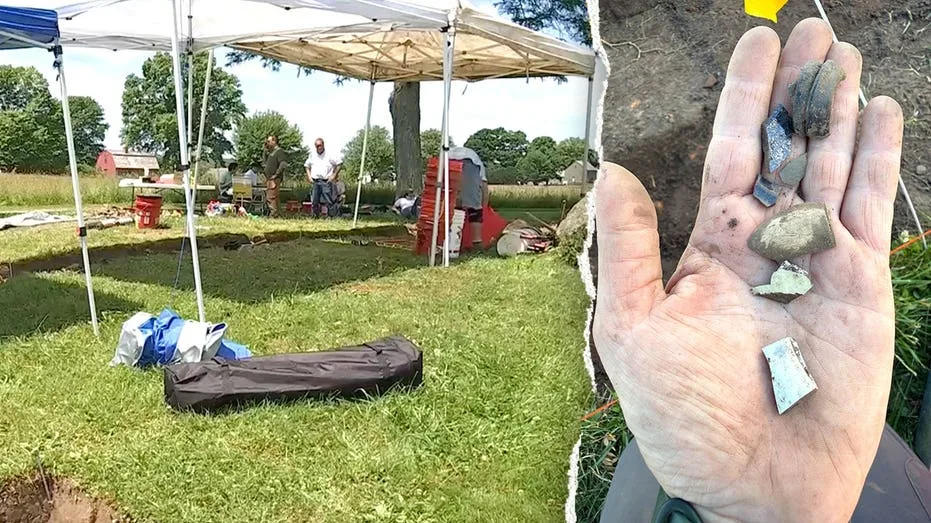
The discovery of the bake house by archaeologists in the New London County community occurred in early June. Images from the excavation site showcase the exposed foundation of the bake house, alongside various smaller artifacts.
Uncovering 18th-Century Military Life
While the site yielded a relatively small number of artifacts, as noted by Connecticut state archaeologist Sarah P. Sportman, one particular find stood out: gunflints.
"Gunflints were chipped pieces of stone used in flintlock firearms, like the ones used during the Revolutionary War," Sportman explained. "The stone is used to create the spark that ignites the powder and fires the weapon."
Many of the other items recovered during the excavation were more common and reflected different historical periods of the site. Sportman detailed the findings:
"In the top layers of [soil], we found some ceramic and glass fragments that date to the late 19th century," she said, suggesting general landscaping work. "As we got a little deeper, we found some older [pieces] ... [plus] late 18th century ceramic fragments, a few pieces of animal bone, clay smoking pipe fragments and older bottle glass."
Despite these finds, she reiterated that "overall, though, the number of artifacts was quite low."
Confirming a Long-Held Historical Belief
Historians had long speculated about the presence of a French bake oven on the town green, with its presumed location even marked by a commemorative plaque. An amateur excavation in 1896 reportedly uncovered masonry and bricks at the site, but this earlier dig lacked documentation such as maps, photographs, or preserved artifacts, making the current effort the first modern archaeological exploration of the bake house.
"As far as anyone knew, that 1896 exploration was the only excavation ever carried out at the site and our work bears that out," Sportman commented.
Researchers initially harbored concerns that the 1890s excavation might have compromised the foundation. However, it appears "largely intact and filled in with a great deal of stone rubble."
Sportman indicated that the structure was likely intended to be "semi-permanent," given that the military encampment in the area persisted for several months.
"The foundation is not very robust and doesn’t exhibit tightly built stonework," she observed. "However, it is certainly more permanent than the earth ovens that troops on the move used for a couple of days at a time ... It looks as though it used stone as a base and brick for much of the actual oven portion."
Ongoing Research and Broader Historical Significance
The discovery of the oven marks a significant step, but the investigation is far from complete. Sportman stated that researchers are continuing their efforts to identify the structure's specific style and to gain a more comprehensive understanding of the surrounding area.
"A ground-penetrating radar survey carried out prior to the dig indicates that the stone and brick structure we excavated was part of a possible complex of structures in this part of the green," she elaborated.
Future plans include additional testing in the fall, which researchers hope will help clarify these features and provide further insight into the site.
Sportman underscored that the bake house excavation is merely one component of a larger archaeological and historical initiative underway in Lebanon, coinciding with the nation's 250th anniversary. Experts have already identified "numerous sites related to 18th-century militia training and the possible location of the French hospital, demonstrating the scale of Revolutionary War activities in Lebanon."
The project also holds profound historical importance due to the Lebanon encampment's role as part of the route taken by French troops under General Rochambeau, who arrived to assist American colonists in their struggle against British rule.
"It is an important reminder that the American victory required significant help from our French allies — and such partnerships have always made us stronger," Sportman concluded.