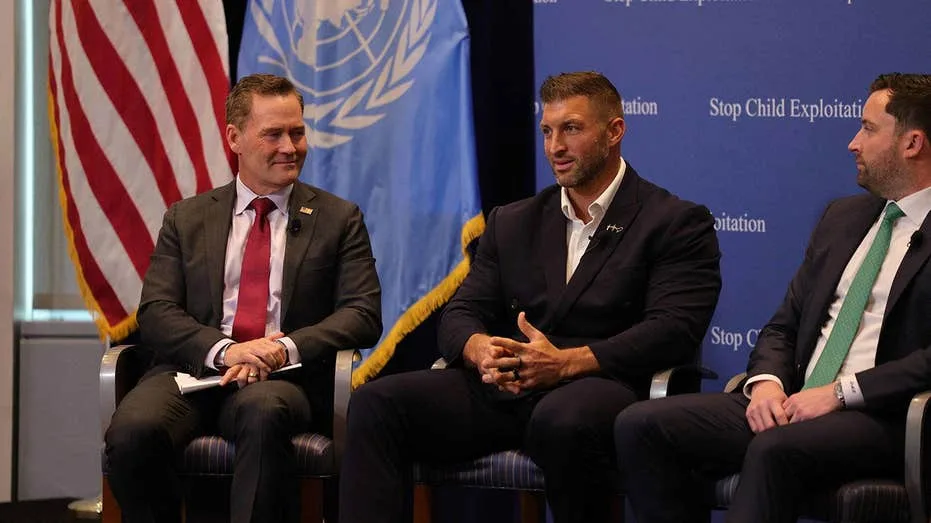
U.S. Ambassador to the United Nations Mike Waltz and former NFL quarterback Tim Tebow jointly announced a significant international initiative on Thursday aimed at combating online child exploitation. This renewed effort seeks to foster collaboration among government officials, law enforcement agencies, and anti-human trafficking organizations, including the Tim Tebow Foundation, to enhance cross-border responses against predators.
The launch event underscored the United States' commitment to partnering with nations worldwide to rescue exploited children, dismantle human trafficking networks, and bring child predators to justice. Speakers highlighted recent international operations, new financial support from Congress, and a U.S.-led United Nations resolution specifically addressing online sextortion.
A Global Threat Requiring a Global Response
Ambassador Waltz emphasized the critical need for an international approach to this pervasive issue. "The United States is leading the charge to combat child exploitation in partnership with civil society groups like the Tim Tebow Foundation," Waltz stated during the event. He added, "Child exploitation criminals operate across borders, so a global response is critical. We need to work together to protect our children from predators."
Tebow underscored the daily danger children face online, urging parents to remain vigilant. He advocated for the use of available online safety tools and encouraged active parental engagement with their children's digital activities, noting that predators are constantly seeking vulnerable young victims.
"There are so many predators online that are looking for a vulnerability and an access to a boy or girl so that they can exploit, so that they can lure, so they can groom, so that they can sextort," Tebow explained. "I really believe it's one of the worst evils in the world."
Echoing Waltz's sentiments, Tebow reiterated that the nature of child exploitation necessitates a unified international response.
"Child exploitation requires a response as global as the threat itself," he affirmed. "Right now, children around the world are being harmed, and we cannot look away. No child should be invisible, and no predator should be able to hide."
Addressing Legal Gaps and Enhancing Capabilities
Waltz acknowledged the varying legal and enforcement landscapes globally, which can hinder prosecution. "I don't know that there's countries refusing to cooperate," Waltz commented, "But what I can tell you, there's countries all over the world [where] they don't have the laws on the books that make these things a crime. They don't have the extradition treaties. They don't have the prosecutors or the investigators that know how to handle the electronic evidence in the right way."
He further explained that U.S. agencies and United Nations partners are actively working to bolster these capabilities in other nations through specialized training and international collaboration. Waltz also drew a connection between migration and human trafficking, observing that vulnerable girls are frequently exploited by criminal organizations along migration routes.
Challenges in Victim Identification
Tebow highlighted the immense difficulties investigators worldwide encounter in identifying victims, largely due to offenders' deliberate efforts to evade detection. He stressed the need for adequate funding, equipment, and training for those on the front lines.
"When we also talk about this, there are so many places that are underfunded, under-equipped, and it does take some training and understanding of what is happening online so we can best use victim identification," Tebow stated. "Those victim identification specialists really are specialists. They're incredible at what they're doing because those that are performing this evil, they're not trying to get caught."
He concluded by emphasizing the dedication required to bring perpetrators to justice and, more importantly, to liberate children from exploitation.
"So it takes really special people to be able to understand, to find them and then bring them to justice. More importantly, bring that kid into freedom."
This collaborative initiative, involving the U.S. Mission to the United Nations, the Tim Tebow Foundation, and international law enforcement partners, aims to fortify cross-border efforts against child exploitation through expanded cooperation, advanced technology, and coordinated investigations.