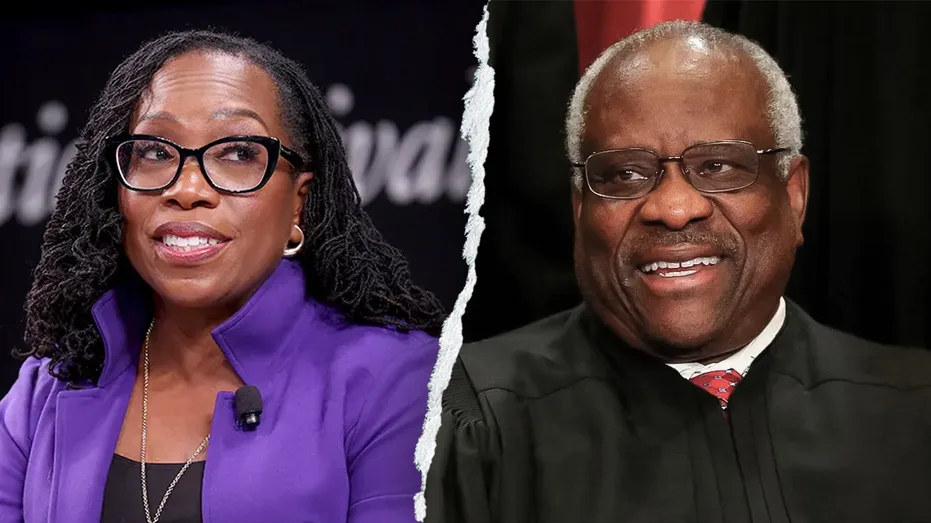
During a recent Supreme Court proceeding, Justice Ketanji Brown Jackson contended that Justice Clarence Thomas's stance against upholding birthright citizenship mirrors a fundamental principle of the historically controversial 1857 Supreme Court decision, Dred Scott v. Sandford.
In her concurring opinion with the majority in the case of Trump v. Barbara, Justice Jackson articulated that the 14th Amendment's citizenship clause was historically intended to grant citizenship to all individuals born within the United States, a scope she believes includes children of undocumented immigrants. This perspective contrasts with Justice Thomas's assertion that the amendment was specifically ratified to confer citizenship upon formerly enslaved people following the Civil War.
"Freed Blacks fought for the shared humanity of all people. And the Great Emancipator eventually foresaw that the only path forward that could prevent a return — in any form — to slavery and race-based subordination was to link the fates of all," Justice Jackson wrote. "Of course, the ultimate irony is that for all the talk about the detestable Dred Scott decision, the Government and [Thomas] propose a return to its core tenet. Their bottom line is that, for certain people, being born on American soil will not suffice to confer citizenship."
The Dred Scott decision, to which Justice Jackson referred, was an 1857 Supreme Court ruling that concluded individuals of African descent were not considered, nor intended to be considered, "citizens" under the Constitution and therefore could not claim the rights and privileges afforded to U.S. citizens.
Justice Thomas's Interpretation of the 14th Amendment
Justice Thomas, however, argued that Justice Jackson's broad characterization of the 14th Amendment's historical context lacked adequate support.
"After the Civil War, the Reconstruction Congress overruled Dred Scott, first with the Civil Rights Act of 1866, then with the Citizenship Clause of the Fourteenth Amendment," Justice Thomas stated. "Both the Civil Rights Act and the Citizenship Clause guaranteed citizenship to persons born and domiciled in the United States regardless of their race. Neither guaranteed citizenship to persons who were not domiciled in the United States."
Justice Thomas proceeded to elaborate on what he perceives as a crucial distinction between Black Americans and foreign nationals residing in the country.
"Blacks were entitled to citizenship because they were Americans. They had no other homeland, owed no allegiance to any foreign power, and were subject to no other authority," he explained. "The same could not be said for the children of foreign temporary visitors. Foreign temporary visitors were attached to their home country, lacked similar bonds to this country, and would not be called upon in time of war."
According to Justice Thomas, citizenship under the 14th Amendment necessitates both birth within the United States and "domicile." He defined "domicile" as encompassing both an individual's physical residence and their unwavering allegiance to the nation. He contended that children born to foreign temporary visitors do not meet this qualification because, despite being subject to U.S. laws during their stay, they maintain ties to another sovereign power and are not fully "subject to the jurisdiction" of the United States in the constitutional sense.
Jackson's Rebuttal and the "Second Founding"
Justice Jackson strongly rejected this line of reasoning, labeling it "myopic."
"Despite his longstanding endorsement of a ‘colorblind’ Constitution, Justice Thomas now surprisingly suggests that the Citizenship Clause was a race-conscious remedial measure, relating only to ‘freed slaves such as Dred Scott,’" she wrote. "It is for this reason, he says, that ‘children who were born in the United States but [to parents] not domiciled here’ are not entitled to claim birthright citizenship. But that narrow vision of the Fourteenth Amendment bears little relationship to the history of its ratification. Even worse, Justice Thomas’s telling elides the entire point of the Second Founding."
Justice Jackson concluded her argument by asserting, "The Reconstruction Amendments were an anticaste, antisubordination reset for the Nation, not a mere spot treatment for the dark stain of slavery."