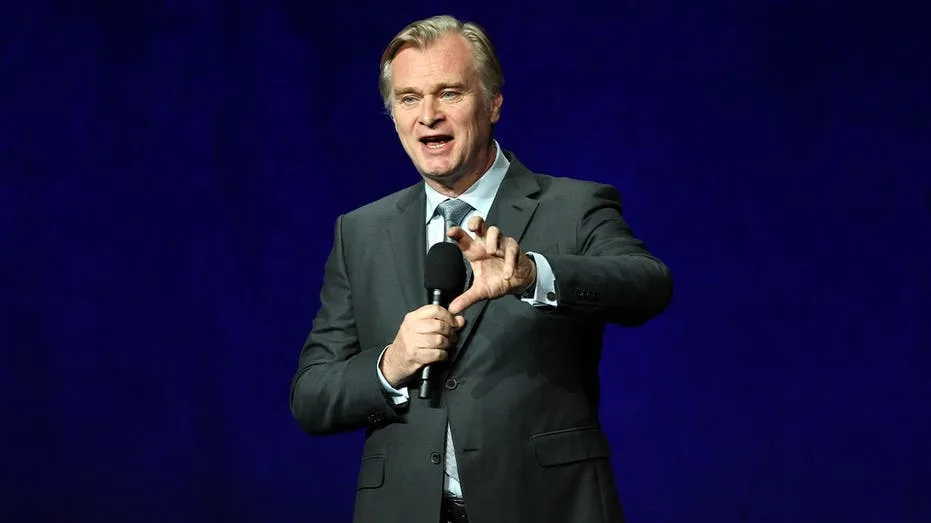
Christopher Nolan's upcoming film, "The Odyssey," has become a significant focal point of cultural discussion, intensifying as its theatrical release approaches. The adaptation has drawn considerable scrutiny in the months leading up to its highly anticipated debut. Much of the commentary centers on the casting of Lupita Nyong'o as Helen of Troy, a role traditionally depicted as White, and the inclusion of Elliot Page, a biological female, portraying the Greek warrior Sinon. Additional points of contention include the film's contemporary dialogue and its apparent influence from Emily Wilson's interpretation of the classic Greek epic.
Now, Nolan is facing accusations of dismissing legitimate concerns or queries about the film's distinctly liberal creative direction by labeling these critiques as "irrelevant."
The Director's Perspective on Backlash
In an interview with The Telegraph, Nolan acknowledged that the controversy surrounding the film "comes with the territory." He further elaborated, "These conversations that happen before people see the film – they’re always irrelevant, because no one having them knows what the film actually is yet."
While it is true that making definitive judgments about a film before its general release can be premature, especially when only a select group of critics and press have viewed it, Nolan appears to suggest that valid criticisms hold no weight simply because the wider public has not yet seen the movie.
Controversial Casting Decisions
A recurring question among moviegoers is whether the practice of race-swapping characters is a widespread concern. For the most part, audiences have frequently encountered White characters reinterpreted by Black actors and actresses over the last decade. These decisions are often perceived as stemming from a specific progressive political agenda, including principles of diversity, equity, and inclusion (DEI).
Numerous examples exist across recent media: a Black actress in the live-action "Little Mermaid," Black dwarves and diverse elves in "Rings of Power," a Black actor set to portray Professor Severus Snape in the new "Harry Potter" series, Black actors and actresses in the Velaryon house in "House of the Dragon," and the casting of Rachel Zegler (of Colombian heritage) as Snow White in the live-action adaptation, among others, with "Wheel of Time" also featuring multiple race-swapped characters.
However, some casting changes are overlooked by audiences if they do not overtly convey a modern political message of DEI or significantly alter the character or narrative. For instance, the race-swapping of Commissioner James Gordon in "The Batman" (the most recent adaptation starring Robert Pattinson, distinct from Christopher Nolan's trilogy) elicited minimal, if any, backlash. This contrasts sharply with the strong reactions to casting Lupita Nyong'o as Helen of Troy or Zendaya as Athena.
Given that "The Odyssey" is a Greek Epic, Helen of Troy is not historically African, and Athena is a Greek goddess. The decision to race-swap these particular characters inherently carries a political dimension, warranting critical examination. To dismiss such criticisms as "irrelevant" appears to be an act of arrogance or evasion rather than a substantive response.
The film also faces scrutiny regarding the casting of Elliot Page, a biological female portraying a male Greek warrior. This choice is viewed not only as race-swapping but also as gender-swapping, another move interpreted as a clear political statement rooted in DEI principles. Criticizing this casting decision is considered entirely justifiable.
These specific criticisms, it is argued, should not be disregarded. The controversy, which stems from Nolan's casting choices rather than merely from critics questioning them, demands a direct response. Filmmakers should acknowledge their decisions, offer justifications, and stand by them instead of deflecting.
Debate Over Modernized Dialogue and Source Interpretation
Nolan further commented on his approach, stating, "What I learnt over my time on [the Batman] trilogy is you can’t worry about any of that [criticism] at all. What you have to do is honor the original text by interpreting it in the strongest way you personally can."
The most effective way to "honor the original text" would be to adapt it faithfully. Critics argue that these creative choices appear subversive, injecting political and divisive statements whether intended or not.
Concerns from audiences about the film potentially drawing inspiration from, or directly utilizing, Emily Wilson's liberal translation of the Greek Epic are also deemed relevant. These concerns are crucial to the story's adaptation for the screen, especially considering Nyong'o's remarks on Homer's perceived lack of female representation (a claim often disputed), Nolan's statement on "The Four Cast" that the film was made for "modern audiences," and a general understanding of Wilson's translation. These elements make audience concerns understandable.
Nolan has also been perceived as dismissing critics during the film's pre-release press circuit, particularly when questioned by "The Four Cast" about the use of contemporary language, such as Tom Holland's Telemachus saying "dad" and Robert Pattinson's Antinous saying "daddy." He characterized this criticism as rooted in illogical "cultural prejudice."
Historical scholars note that the term "dad" did not become culturally common until the 17th century, thousands of years after "The Odyssey" was believed to have been composed. Therefore, asserting that discomfort with unfaithful source material is merely "cultural prejudice" is seen as problematic.
While certain audiences and publications might dismiss dialogue critiques as trivial, for a filmmaker renowned for creating immersive cinematic experiences, such anachronistic language can disrupt the illusion of an authentic Ancient Greek world. It feels out of place in the very setting the film purports to portray faithfully. This criticism, it is argued, is far from irrelevant.
Ultimately, while "The Odyssey" may prove to be a competent film, it presents several clear issues that warrant open debate and discussion. If Nolan's true intention was a modern interpretation of "The Odyssey," as he has indicated, perhaps setting it outside of Ancient Greece would have resolved many of these controversies.