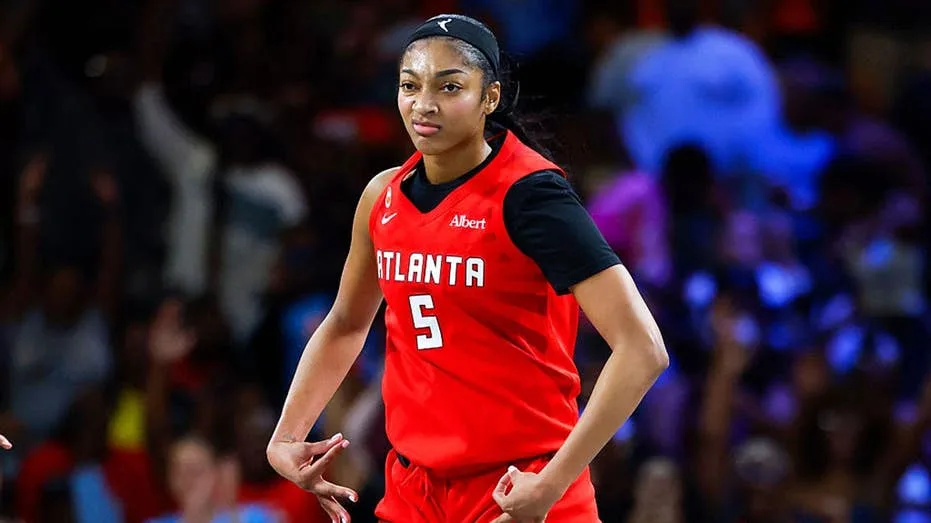
The Women's National Basketball Association often finds itself at the center of public attention, and a recent incident involving Atlanta Dream forward Angel Reese further contributed to this trend, drawing significant online discussion.
On-Court Dominance, Off-Court Spark
On Friday evening, Angel Reese showcased a stellar performance as the Atlanta Dream secured a commanding 111-92 victory over the Toronto Tempo. Reese was a dominant force, contributing 23 points on 7-of-11 shooting and grabbing 12 rebounds. Her impressive play on the court was widely noted.
However, the game also featured a moment of contention. Late in the contest, Reese collided with Tempo forward Nyara Sabally. Sabally sustained a rib injury on the play but was ultimately assessed a shooting foul. She required assistance to leave the court.
The Controversial Remark and Online Reaction
While Sabally was still on the ground, Toronto Tempo head coach Sandy Brondello approached the officials to argue her team's case. A hot microphone captured a portion of Brondello's conversation, during which she referred to Reese as a "protected species." This comment quickly circulated, prompting a significant reaction across social media platforms, with many interpreting it as racially charged.
One social media user posted on X, stating, "Calling a black woman a species ...", to which Angel Reese publicly responded, "ARE WE SURPRISED?!" Her reply also tagged Coach Brondello, further amplifying the conversation.
Understanding "Protected Species" in Sports
The interpretation of Brondello's remark immediately became a central point of contention. Critics of the racial interpretation highlighted the importance of context. Coach Sandy Brondello is Australian, and in Australian colloquial speech, the term "protected species" is often used to describe someone who receives preferential treatment. This nuance was quickly pointed out by many online commentators, though it appeared to be overlooked by others.
Furthermore, the phrase "protected species" has a long history of use within sports discourse, referring to star athletes who appear to receive more favorable calls from officials. Examples frequently cited include:
- In the National Football League (NFL), quarterbacks like Patrick Mahomes and formerly Tom Brady are often humorously referred to as "protected species" due to the strict penalties defenders face for contact with them.
- LeBron James in the National Basketball Association (NBA) has been described this way over his decades-long career, with observers noting his ability to draw fouls.
- In Major League Baseball (MLB), veteran players, particularly pitchers and hitters, sometimes receive calls that might not be extended to less experienced athletes. For instance, a seasoned pitcher like Justin Verlander might get a strike call on the edge of the zone that a rookie would not.
- In college football, some have argued that the University of Alabama, particularly during Nick Saban's coaching tenure, was treated with a similar level of deference.
These examples underscore that "protected species" has been a common, non-racial sports idiom for an extended period.
The Impact of Social Media Amplification
Despite these contextual explanations, the narrative that Reese was subjected to a racial slur gained traction, particularly given Angel Reese's identity as a Black woman. Commentators suggested that the selective focus on the word "species" without the full context led to a misrepresentation of Brondello's intent. Reese's decision to repost the fan's comment with a sarcastic reply and a clown emoji was perceived by some as amplifying a potentially misleading narrative, drawing attention away from her on-court achievements.
This incident follows a recent controversy where a fan was dismissed from their employment after allegedly sending a racial slur to WNBA player Chelsea Gray. Gray shared the message online, leading to widespread condemnation and the fan's termination. In that instance, the evidence of a racial slur was explicit and widely accepted.
However, in the case of Reese and Brondello's comment, many argued that the situation was fundamentally different. Critics expressed concern that framing the "protected species" remark as racist, despite its established sports context, created an unnecessary controversy and overshadowed Reese's impressive athletic performance, shifting the public conversation to accusations of racism.