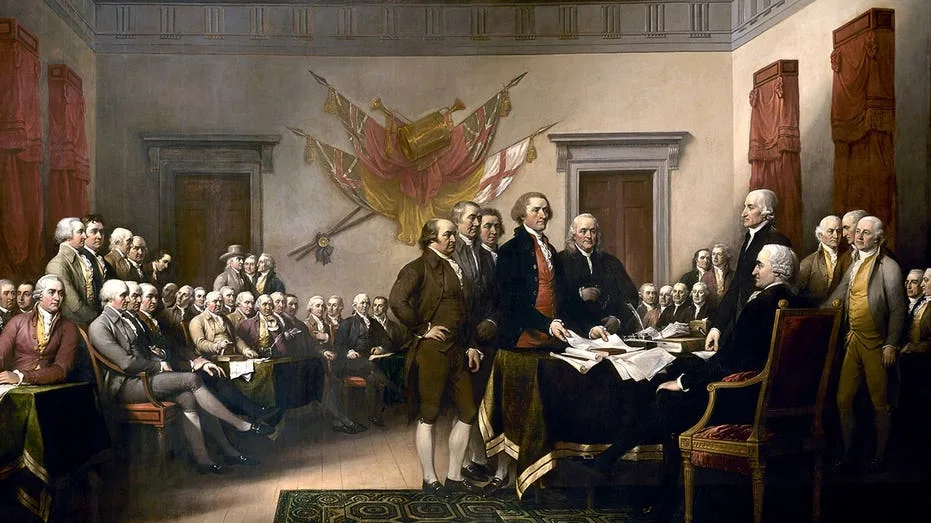
The profound connection between the United States and the Jewish people is not a recent development, nor did it commence with the establishment of the modern State of Israel. In fact, this relationship predates America's own founding nearly 250 years ago. It has always been understood as a covenant, a sacred bond, rather than a conventional diplomatic arrangement.
Long before the United States came into existence, a people were learning to govern themselves based on principles revealed at Sinai.
Historical Roots of a Unique Bond
The early Puritan settlers in America did not view these biblical narratives as distant history but as an unfolding blueprint for their own society. In 1630, their leader, John Winthrop, delivered his renowned sermon, "A Model of Christian Charity." He concluded by echoing the words of Moses to the Children of Israel on the threshold of the Promised Land, urging his followers "to love the Lord our God, and to love one another, to walk in his ways and to keep his Commandments and his Ordinance and his laws, and the articles of our Covenant with him."
The Mayflower Compact itself was perceived as a covenant, distinct from a mere contract. Its signatories understood that while a contract is fundamentally transactional, a covenant is consensual, founded upon principles of freedom and personal responsibility.
Scholar Os Guinness, in his work America Agonistes, argues that the true wellspring of the American Revolution lies not in the philosophical traditions of Greece or the common law of England, but in the Jewish concept of a people who freely and morally choose to bind themselves to one another and to God. Guinness states, "America’s debt to the Jews is deepest when it comes to the Hebrew contribution to the founding genius of American freedom."
Founders' Vision and Early Advocacy
America's founders frequently voiced their admiration for the Jewish people's contributions to civilization. John Adams, for instance, wrote, "The Hebrews have done more to civilize men than any other nation…. and have influenced the affairs of mankind more and more happily than any other nation, ancient or modern."
Adams also held what would now be considered Zionist views. In his correspondence, he explicitly stated, "I really wish the Jews again in Judea an independent nation."
Walter Russell Mead's book, The Arc of a Covenant, highlights that the conviction supporting Israel in America was historically not primarily a Jewish one, but rather a predominantly Protestant sentiment.
This sentiment was evident in 1891 when evangelical minister William E. Blackstone presented a petition to President Benjamin Harrison. The petition advocated for the restoration of Palestine to the Jewish people, asserting, "According to God’s distribution of nations it is their home—an inalienable possession." Among the influential signatories were prominent figures such as J.P. Morgan, John D. Rockefeller, the Chief Justice of the Supreme Court, members of Congress, governors, mayors, and various other officials, publishers, educators, and clergy members.
Mead's extensive research suggests that long-standing cultural predispositions and habits, rooted in America's identification with the Hebrew scriptures, have profoundly shaped U.S. policy towards Israel, often more significantly than the influence of any particular organization or presidential administration.
Modern Alliance: Shared Values and Strategic Depth
In the contemporary era, following the Jewish people's re-establishment of sovereignty in their War of Independence, the relationship between America and Israel has been anchored in shared interests and fundamental values. Israel's founding document reflects the same moral framework as the American Declaration of 1776, asserting the existence of certain inalienable rights that precede government and are derived from an authority higher than any legislature or military force.
The essence of the U.S.–Israel relationship extends beyond crucial aspects like intelligence-sharing, joint military exercises, or Israel's innovations in fields such as water technology, medicine, and cybersecurity. Its true foundation lies in the shared, audacious idea that both nations were born from the concept of people covenanting themselves to liberty and law under divine guidance.
This relationship serves as a deep mirror. When America observes Israel's tenacity, its remarkable survival against formidable challenges that have overwhelmed more powerful empires, and its unwavering commitment to democracy in a region largely devoid of it, America discerns a reflection of its own valuable struggle.
An Enduring Covenant
These profound connections motivated the author to establish the U.S. Israel Education Association 15 years ago. The organization's mission is to educate American leaders about this vital collaboration, strengthen the bond, and ensure its benefits for the United States far into the future.
As America approaches its 250th anniversary, the nation may not necessarily require more allies, but it certainly needs to recall and cherish its origins and its covenantal legacy. Both America and Israel emerged from the narratives of the Jewish Bible, sharing a common script that defines their identity and shapes their perception of the world. This shared heritage is precisely why the alliance with Israel runs so deep and is poised to endure even the most formidable opposing forces.